Sunday, 6 March 2011

What it is All About!

There is only emptiness – vast spaciousness like the infinite blue sky or like the deepest silence beyond all sound.

There is no “me” – all I perceive is not me; thoughts, feelings, sensations, images which are apparently inside me; and  phenomena, things, apparently in a place called the world which "I" observe. In reality, on my shoulders is just a blazing empty space; not separate from the vast spaciousness of all.

There is no "I" or "me" to be healed,  improved, or become enlightened. Enlightenment is not an experience – it is the demolition of all concepts; all that we think we are.  There is no path to truth – it just is; here and now.

Resting easily in the natural state, emptiness arises readily and is luminously clear. There is no perceiver of this emptiness. Not being separate from this empty, loose and natural space allows the experience of the inseparability of emptiness and the phenomena that arise in the emptiness; thoughts, feelings, insights, perceptions, experiences. All experiences and phenomena are empty and are not different to, or separate from emptiness they are like two sides of a coin. This emptiness is not an absence but a fullness, a spaciousness that contains all. The world is not an illusion; it is the viewer who is the illusion.

The tantric formulation of this is that everything is Shiva; universal consciousness. If we don’t have this as the root realisation then we either embark on a futile game of self-improvement;  trying to  become more spiritual or more whole; or we chase phenomena such as more powerful experiences, bigger orgasms, greater realisations.  All experiences and phenomena are empty and the experiencer, being not distinct from this spacious emptiness is also empty. Phenomena of all sorts are the manifestation of Shakti - the dynamic, creative power of the universe. Therefore if we only see and worship Shakti then we are tying ourselves into the manifest world. If we are rooted in the realisation that everything is consciousness (“I am Shiva”) then we can experience Oneness; the inseparability of form and emptiness, energy and consciousness Shakti and Shiva beyond all dualities. This is true advaita tantra. 

Deeply realising this either as a gradual dawning or as a sudden awakening puts much of what happens in tantra workshops into a different perspective. 

Monday, 14 February 2011

Flowers of Emptiness

I have just come back from two weeks in Goa, India. It is a beautiful, warm simple life there; probably much like the Mediterranean fifty years ago before big hotels and package holidays started.  In all the many hours I spent sitting in cafes meeting many, many Europeans I only met one person who was there for their annual holiday for three weeks. Every other person I met was there for many weeks or months or sometimes years (with excursions out of the country to renew their visas). Some were "finding themselves"; some had hopelessly lost themselves; some had probably smoked far too much dope; some had put in many hours of meditation or yoga or spent years in spiritual practice, some just travelled and travelled. Some were in their early 20's others in their 60's.

I wondered what the hard-working Goan  fishermen made of these westerners practising their poi on the beach or drumming at sunset. It is hard not to judge. Spiritual growth requires awareness and relaxation into being; but paradoxically is forged in the activities of life. If we have not cultivated awareness then relaxation and lack of challenge usually leads to dullness and sleepiness. All spiritual teachers are trying to get us to wake up!

 I was reminded of Kahil Gibran's words in The Prophet that work is love made visible and that we work to keep pace with the world. Everyone's path is very mysterious ; usually to themselves and invariably to anyone else. The most powerful yoga is kriya yoga and "kriya" means action!

Monday, 22 November 2010

Barotse

I am back from two weeks in Western Zambia with many memories. Strongest is the sculptured groups of black mat skin. The women with silent wide eyed children; the large group of girls, some carrying younger children and small boys. There were a few young men, usually near the edge of the group. Most of the men were in the fields. It was as if they were posed for a photo of beauty, dignity, with an air of welcome; unperturbed by the differences which bothered me so much.  We arrived in a gleaming white Toyota with plastic chrome; four white middle aged or elderly men and a couple of local people.  They had very little in some villages; no cattle or goats or chickens,  just huts and a diet of maize and cassava. They found some chairs and we sat in the shade of the tree on the poor sandy soil. Nearby was the hand pump; the subject of our visit.

I notice how in the West poverty is shameful and differences awkward. They seemed at ease with this and peaceful, open, welcoming; shaking hands at every opportunity. No one could envy their suffering, their very basic existence and there is certainly nothing ennobling in poverty. But they can more easily attain a natural relaxed state in a world of few distractions and little pressure beyond the daily tasks of survival.  No mobile phone signals reach here yet; no satellite dishes, no internet; (but not for long I fear).

We came to see how they were managing with the new well made after they had accepted out demand that they construct and use pit latrines and wash their hands. A small imposition on them which can save the lives and the sight of their children, nearly half of whom will otherwise be struck by simple illnesses.

I hope there is some way that their lives can be improved without being spoilt. That the usual development doesn't lead to an exodus of the young from rural life to live in the sprawling cities where  half the world's population now live. I don't know what would make that possible but at least basic sanitation and water make health a real prospect.

Saturday, 18 September 2010

Polyamory


So many songs are written about love. Here in the West we have a religious tradition of Christianity - a religion  based on love (though some pretty unloving things have been done in its name!); and in tantra we often see the heart chakra as the centre of the body and the transformer and gateway from the three lower - but not lesser chakras to the three higher ones. The heart is the centre of love. So it seems a bit strange that little attention is given to how and where love flows in our lives. Who do you love? How do you love? What are the limits of love?

 I am not going to answer these questions but Dr. Deborah Taj Anapol, after training as a clinical psychologist has spent most of the last thirty years, trying to understand this in her own and others lives. Her first book Love without Limits was published nearly twenty years ago. She has written about the Seven Laws of Love and has now just published Polyamory in the 2st Century. Summarising this and giving many examples of the lives of those, who from choice or necessity have lived in a different way. Her website www.lovewithoutlimits.com  has some excellent articles on it. She has been staying at my house and is a lovely person who runs great workshops. 
Imagine a world where our hurt and pain about love wasn't running us and where we didn't operate as if love was in short supply!

Monday, 16 August 2010

Tantra and Yoga are Sciences

New Age Chakras
New Age Map

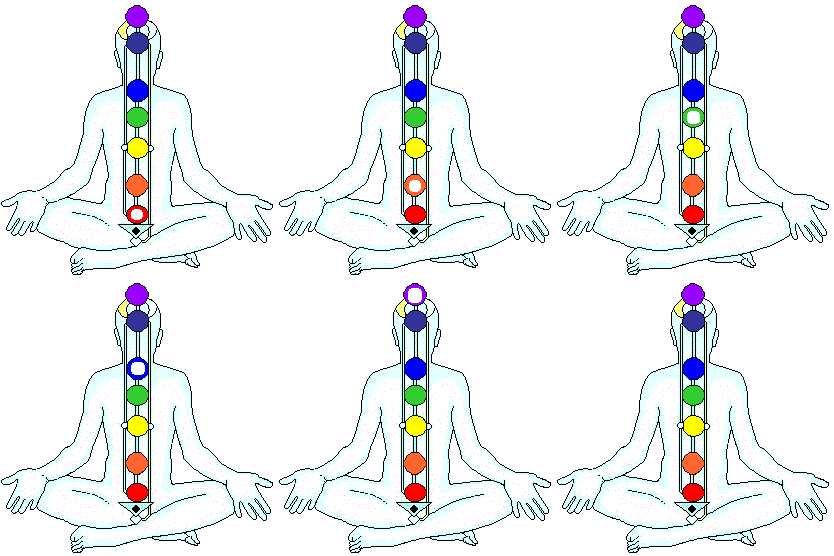
The New Age is full of versions of "anything goes" or "whatever you believe is true" or " you create your own reality", all of which are the opposite of a science, where things have to be tested and verified and considered in relation to previous truths. Here is a small example.The chakras are centres in the body which connect physical and energy bodies together. They are important in tantra as part of the map by which we can move energy and consciousness through the body. The chakras are actually rooted inside the body near the spine but I will only talk of where they "surface" at the front.  If you look in most modern western books the Third Chakra, traditionally called Manipura (City of Jewels) is located at the solar plexus; just below the ribcage and the second chakra is at the level of the navel. The third chakra is usually called the Solar Plexus Chakra.  Above are typical New Age pictures of the chakras.

Traditional Chakra Map

However, traditionally in all the ancient texts Manipura is known as the Solar chakra and not connected with the solar plexus. It is also sometimes called the Navel Chakra, Nabhi Padma and its location is at the navel or, some yogis even suggest one finger width below the navel. This is where the New Age puts the second chakra! Traditionally the second chakra is two finger widths above the pubic bone. Basically everything has shifted by one chakra and been moved up about four inches!  Here is a typical picture of this version. Notice the positions of the second and third chakras.

Traditional Chakra Map


How did this happen? It probably stems from a misunderstanding by Theosophists in the late nineteenth century where the solar chakra got mixed up with the solar plexus. C.W. Leadbeater's book  The Chakras in 1927 certainly has this and influenced the New Age view of the chakras.  They are generally based on using the chakras for healing; whereas in tantra, meditating on the chakras is a means of  dissolving unconscious imprints and obstacles to union with the Divine source.

So if the third chakra is at the navel, put you hand there. This is your centre of power, will and playfulness it is also the hara or tan tien in Japanese and Chinese and a place for the accumulation of energy. It is connected with the element of fire; the fire of the jewel shining like the sun at this centre.

Tuesday, 13 July 2010

How we Hide

The most fundamental aspect of being alive is the pulsation of breath and energy through our bodies. This can be the obvious pulsation of the chest lungs and diaphragm in breathing; the rhythm of the heart muscles and the surge of blood; or the subtle rhythm of the fluid around the brain. Finer pulsations of life are the streamings of energy in the body like a small bubbling stream, or what the Kashmir Shavite tradition of tantra calls spanda usually translated as trembling.

In the bodies of untraumatised young children it is easy to see this quality of pulsation.  By the time most get to adulthood this is lost. The body has become hardened  against pulsation or disorganised so it is chaotic or uninhabited so that it is too loose and unenergised. Traditionally in body psychotherapy the various ways we loose our fluid pulslation and flow are called character structures. They then imprison us for many years and we come to identify with them. We think this is who I am and remain trapped deep inside.  Both body psychotheapy and tantra aim to re-establish this pulsation and flow. For some this means working with the pulsation through breath, sound, movement and perhaps touch in massage. For other people is is more about bringing awareness back to the energy. Tantra is about this dance of energy or aliveness and awareness. Energy being considered as Shakti kundalini and awareness as Shiva consciousness.  From this dance of Shakti and Shiva all life and aliveness comes. 

Raoul Moat who shot himself at the weekend was described as a man-mountain and from the photo I saw had the typical build (which I associate with bouncers) of a very short thick neck and dense body which looked as if compressed as though they had been shouldering a heavy weight for many years.This is a typical maoschistic character structure and caries within it a huge amount of rage for the suppression they experienced when very young.  In a society which valued movement, pulsation, aliveness, expression and emotion there would be many less with such a structure and such rage which can burst out fatally.  The alternative to celebrating and supporting the dance of Shakti and Shiva is death.

Monday, 12 July 2010

I have no dad and nobody cares about me

Just over a month after the last blog about Derrick Bird, here is another on the same theme of men's pain and isolation in Raoul Moat's final lament before he shot himself at the weekend.  He wasn't psychotic or even inarticulate - he wrote a 49 page letter. He was just deeply deeply troubled and unhappy without a good enough foundation in life. It is probably the usual story of insufficient quality mothering and lack of a father and then a life with inadequate internal resources, where too much had gone wrong. He was, like Derrick Bird, faced with a lack of real intimacy and no apparent means of getting any.

When will people realise that good therapy can help? The usual cliché that women see therapists and men see probation officers and alcohol counsellors probably applies. More support for parents, widely available support for couples, good skilled psychotherapy and above all building a culture in which men can be real and intimate and feel valued as men would stop most of the killing and much of the pain.  By good skilled psychotherapy I don't mean a few sessions of counselling with volunteers or a session with the prison chaplain but the sort of individual and group therapy which can get to the roots of psychological pain and make a fundamental difference.  Therapy has been around for well over a hundred years but in Britain it is still marginalised, misunderstood and laughed at.  I have spent some of each week for the last 20 years training therapists and counsellors.  With the new cuts in public expenditure you can be pretty sure that the military, and the pharmaceutical industry will suffer less than the tiny amount of real therapy in the NHS. As for going privately, many men spend more on drink  in a week than the weekly cost of  therapy.